Commissions Are Now Open
Co-create a timeless, intuitive painting that reflects your story, energy, and inner landscape.
Long after the waters receded, the landscape and the work continued to move.
Warning to Reader: This article contains vivid descriptions of flood devastation and trauma.
The scale of the event
The flood has not yet been given a separate official storm name. In government records, it forms part of the severe weather events of 10–14 May 2026. Along the river, it has generally become known as the 2026 Breede River Flood, or in tighter circles the Malgas Flood, but its effects were felt across a much wider area.
First came the severe weather warnings. The rain began in the upper Breede catchment, with Ceres recording 333.2 mm of rain in 24 hours on 11 May—the highest daily total there since records began in 1955. The flowing day (12 May), Clanwilliam Dam rose from 28.6% at midnight to 95.2% by 5 p.m. It was reported full an hour later. By the following day it stood at 103%, with all 13 sluice gates open. It was an approximate increase 87 billion litres in less than a day.
By 6 a.m. on 13 May 2026, the Department of Water and Sanitation’s gauge at Swellendam had recorded a 7.04-metre rise and a flow of 1,990 cubic metres per second.
This was only mid-flood.
At around 10 p.m. on 13 May, the flood appeared to have reached its peak. The water seemed to have stopped rising, and our neighbours, permanent Malagas residents, believed it was finally safe to go to bed. The floodwater by now had already reached the edge of their front porch, with the river more than eight metres above its normal level.
Turning off the lights, the usual river silence was interrupted by a sound that chilled them to the bone. Still in their pyjamas, they stood listening. It grew closer and closer—a terrifying crashing and tearing as trees, jetties and structures were being ripped away and driven downstream.
They ran from the house and scrambled as fast as they could up the steep hillside behind their home. Out of breath, they turned and watched a wall of water and debris, come crashing through below them. This battering ram of water, whole trees, jetties and wreckage smashed into their home, sweeping away almost everything in its path.
The steep slope beneath their feet was the only reason they had been able to escape it.
They sat on the hillside in the darkness and rain as the river continued to rise even further. By morning, their home was completely submerged.
Across the wider Western Cape, the scale was immense. A provincial assessment released in June placed damage from the May storms above R9.09 billion. At that time, 11 people had died, one person was still listed as missing, 231,029 people had been affected, 22,890 homes had been damaged and more than 230 roads required repair. Agriculture sustained losses exceeding R5.2 billion, with more than 1,400 hectares damaged and 1,568 agricultural jobs disrupted.
What was already gathering
The artwork and title came later, yet they capture something I have continued to think about: how an event can begin beyond our sight, accumulating quietly until it arrives as something that changes the shape of everything.
The rain had begun far away in distant mountains. Water gathered over time, moving down through valleys and river systems. Long before we could see what was coming, the force was already building.
“We were the lucky ones.”
Melanie
Our family was safe, and our special river home, although not our primary residenc, remains standing, albeit only partially. The water had moved through it with an unimaginable force, bashing out glass doors and surging through the rooms and passage. Like a giant washing machine, it swirled through rooms; bashing through walls, windows and doors; ripping apart cupboards and carpentry; and leaving our furniture and possessions strewn about.
Mud was everywhere: inside the toilets and basins, spatterend across the roof rafters and dripping from the ceiling fans. Muddy river water had reached well past the ceilings, filling the wall cavities and electrical conduits, soaking into our precious piano.
A lounge couch lay on a neighbour’s roof. A fish swam in a small puddle in the main bedroom. A drowned snake lay among scattered cushions. A tortoise, crushed, brought tears to my drowning heart.
Many items were carried further downstream. Fellow residents found belongings, and even jetties, floating out at sea hundreds of kilometres away.
Objects that had belonged in shrine-like places were found buried in the mud, displaced and strangely exposed. Others simply disappeared. These were ordinary things, but they carried the substance of a life: family history, rituals, memories and the quiet accumulation of over 5 decades of love-filled years.
The river house has never been only a building. For Mike and his brothers especially, it is a place of deep attachment and meaning. For all of us, its damage was not simply the destruction of property. A place that had seemed permanent—a place that held part of a shared history—had been violently altered.
It felt like rape.
“As human beings, we often speak about nature as though it reflects our inner lives. But, standing in that altered landscape, I felt that we exist as one small part of it, within the gathering, the rupture, the release, the loss and the return.”
Melanie
The land was more than a backdrop
Our possessions matter deeply to us. The destruction of a home can be financially devastating and logistically uprooting. It can unsettle a family’s sense of continuity and expose fault lines in bodies, relationships and lives. Yet the scale and motion of the natural world can also remind us that our carefully arranged human structures are small.
Returning to the river to assess the damage, begin digging our home out from beneath two feet of mud and start cleaning, I was deeply struck by the scale of what had happened—not only to homes and people, but to the landscape itself.
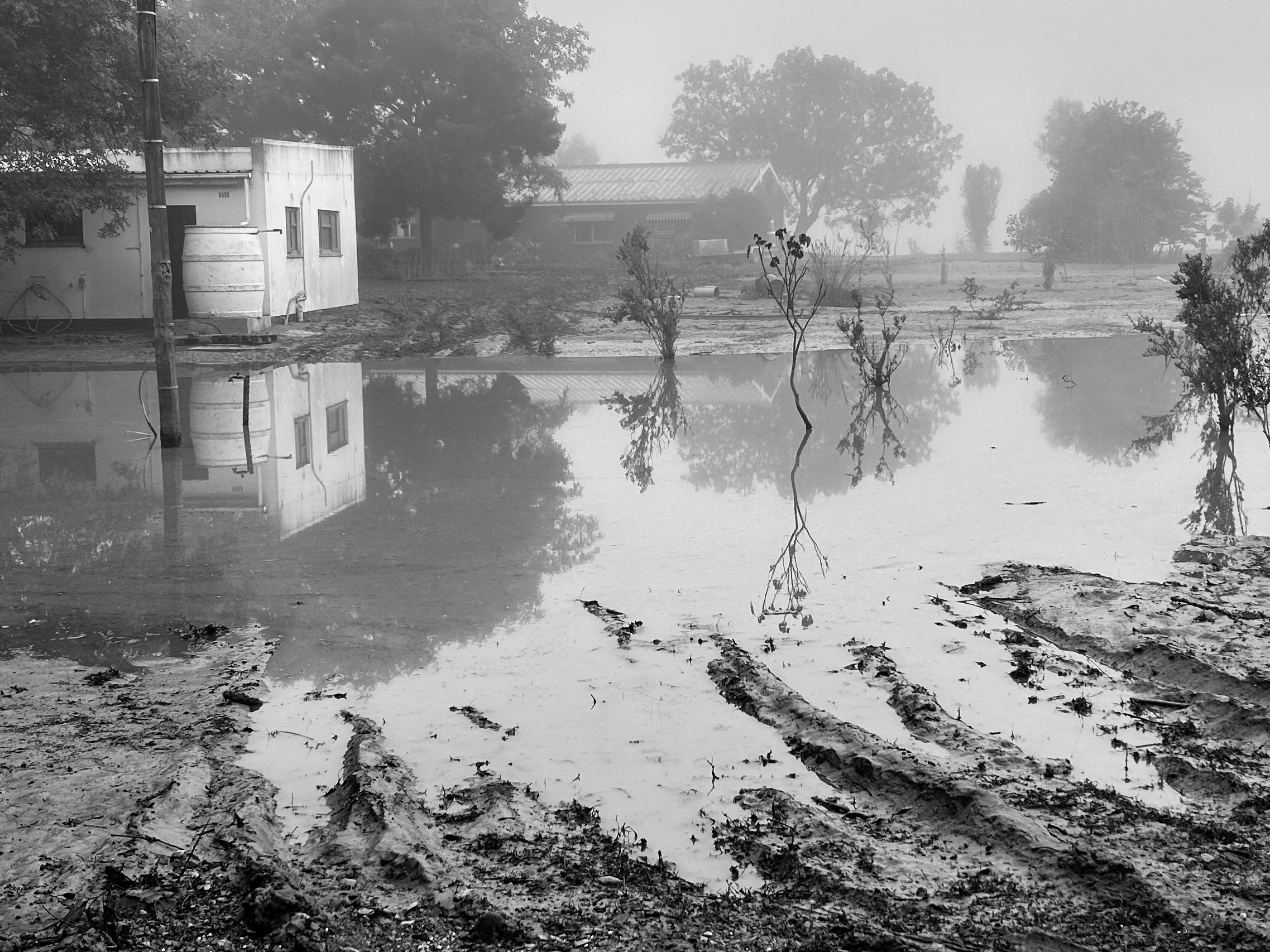
The ground had been scoured, revealing rocks hidden for decades, perhaps centuries. Below the main scour line not one tree remained standing.
I found corposes of animals drowned in the flood, shrinking pools of flood water becoming death traps for fish, insects and small animals caught inside the aftermath.
The flood had not happened against the landscape. It had happened to the landscape.
For days, the rolling hills remained saturated beyond anything they could contain. In the early mornings, mist rose from the valleys and the soaked earth. It was extraordinarily beautiful, but it was also evidence: the ground was still releasing what it could no longer hold.
A body drowned. Saturated.
I began to think of the land as a body—wounded, overwhelmed, breathing out water, continuing to live, fighting for life while still carrying what had happened to it.
It suffered a mortal wound, and yet it was still alive.
Beauty was not proof that everything had healed. The soft rising mist, exquisite as it was, did not undo the destruction. New tracks, spoor and delicate, drew bejewelled spiderwebs did not mean the event was over.
Beauty and trauma were present together. They so often are. Still is.
What the river revealed
Among the devastation was the calm strength of friends and neighbours along the Breede River valley.
Friends arrived with trailers, pumps, generators, tools, food, accommodation, labour and their precious time. Many were dealing with severe losses of their own, yet they continued to help others clean, salvage and begin again.
Even months later, while some still live without running water or electricity, friends and strangers continue to show heart and compassion, reaching out with food donations and support.
The river carried away possessions. It revealed people.
I reconcile this beauty, in the community and landscape, with the hardship, trauma, and suffering endured. The recovery has demanded months of physical work, documentation, insurance administration, financial uncertainty and difficult decisions. Our house is still standing, but only partially intact. The shed gone. However, rebuilding a place and a sense of ground beneath one’s life is a much longer process.
And we continue, one blurry, tear-filled, muddy step at a time.
Returning to the studio
When I returned to painting, I did not set out to document the flood. As many of you know, my work never begins with a fixed explanation or an image I intend to reproduce. I work by listening, allowing movement, material and something less conscious to lead me.
But the flood had entered me, and so, inevitably, the flood enters my paintings.
It appeared in water gathering and boundaries dissolving; in canyons, ravines and passages; in dark foregrounds that required a closer look; and in distant horizons where light remained visible. The works seem to hold pressure and release, damage and possibility, and the uncertain movement through one state of being into another.
Their titles emerged from that same process: What Was Already Gathering. Where Silence Gathers. Where Boundaries Dissolve. Remains in Possibility. The Shape of Becoming. Making Room for Light. The Light Between Us.
And, finally, Where Ground Still Breathes.
More continue to emerge.
These paintings are not illustrations of the flood. They carry something of its movement and experience. They hold the way water gathers before we recognise its force; the way darkness occupies the ground immediately before us while light remains present in the distance; the way a wound can remain alive; and the way recovery does not return us to what existed before, but slowly creates another shape. And the very act of living finds a new home.
We are still inside the aftermath. The land is still marked. The house remains months away from being restored. There is no simple ending, no neat equation in which destruction is transformed into hope.
But the ground is still breathing, while the work continues.